Showing posts with label Agriculture. Show all posts

Saturday, April 7, 2012

Use your words: GMO

I know that this post will cause controversy. And I encourage you to post comments in response to this post. It's ok to have differing views, and I encourage respectful discussion on the matter.

When talking about GMO crops, this is what some people think.

We hear this acronym thrown around all the time. GMO, which stands for Genetically Modified Organism, brings haunting images of frankenstein-like vegetables designed in a lab with a mad scientist concocting new creatures for the fields of America. But let's take a closer look at what GMO crops are all about.

What is GMO?

GMO stands for Genetically Modified Organisms. This normally refers to an organism that has been modified using a non-breeding technique. So, there's normally a gene (or set of genes) that's been inserted using biotechnology. These are interchangeably known as biotech crops.

How are GMO crops different from conventional crops?

GMO crops differ from conventional crops in the way that genetic traits make their way to the final product. Conventional breeding of a crop can take up to 10 years to integrate all the traits needed for a successful crop. GMO crops use a few techniques where those genes can be directly inserted into the genome. The result is a crop that is ready for market in 5 years or less. Typically, there's a gene that normally exists in the gene pool anyway, such as disease resistance or increased yield. However, recent breakthroughs have made it possible to use genes in a different species, such as a salmon for cold resistance.

What kind of techniques are these scientists using?

The first technique was developed at Cornell University in 1987, and is known as a gene gun. The prototype of this was actually a modified bb rifle. The gene gun, or "biolistic particle delivery system" uses a heavy metal (most often gold or tungsten). This gold is coated with DeoxyriboNucleic Acid (DNA), but not just any DNA, the DNA that when decoded will produce the desired trait. So, let's say you want to make super sweet corn, you'd take known "super sweet" genes, multiply them, and then apply them to the gold dust (we're talking small, measured in micrometers). This mixture is shot at the plant you intend to modify, and tada! GMO plant! However, this doesn't always work. As one professor described it to me, it's like dropping a boulder into your house and hoping that you include the piece of DNA in the restoration.

Another technique is the use bacteria. Agrobacterium tumifaciens is a plant pathogen that hacks the plant. Unfortunately, all the bacterium can do in nature is give the plant a tumor. However, researchers over in Belgium realized that the tumor would not go away after the bacteria was removed. After further examination, they realized that the bacteria actually transferred genes to the plant. This bacteria had been genetically modifying plants well before we could. Fast forward a few more years, and researchers have found a way to insert genes into this circular piece of DNA (called a plasmid) into plants with the traits they want. It's similar to putting a CD into your computer.

There are several other ways to genetically modify a crop. But these are the two most common forms. Viruses can also be used along with double haploids.

What kind of traits can you put into my food?

Depending on the crop, there are many traits that are desirable. For example, people around my area LOVE sweet corn, the sweeter the better. So, isolating and inserting genes into a variety of corn to make it sweeter is something we all want. Another trait that is always sought is resistance to disease, so once researchers isolate the gene (or genes) wanted, they can proceed with developing a better crop for the future. One of the most famous crops that was saved from a virus is the papaya. Read about it here.

Is it safe?

YES! This is something that most people don't realize about GMO crops. All GMO crops that are grown commercially are Generally Regarded as Safe (GRAS), an FDA label. Check out this information sheet on how the FDA tests GMO crops here. When genes are first inserted into plants, it's normally 4-5 generations before large scale production, so if you're afraid of a gold allergy, you have nothing to worry about. Also, the genes being inserted are very specific, and well documented. It is considered extremely irresponsible for scientists to use the gene gun filled with an unknown gene mixture just to "see what grows".

So once they have a "prototype" of a potential crop; something that has been transformed and a small scale. The prototype is sent off to third party agencies to be examined (USDA, FDA, and the EPA to start). This is a heavily regulated sector of agriculture, and for good reason. If something were to go wrong, this is the time to catch it. The regulatory agency goes through each prototype with a fine tooth comb, proving that the gene (or genes) have been inserted, and that any proteins that gene makes are safe and familiar to the human body.

To conclude, I think that many people who don't understand this technology are quick to dismiss the potential benefits of GMO crops. Rather they base opinions on emotions of fear of the unknown. However, we aren't producing any new farms (at just 2% of the workforce in farming) and people need to be fed. The population is expected to double by 2050, and we're going to need feed those people somehow. Better crops, along with better management of our resources, we will be better prepared to feed these people.

Sunday, April 1, 2012

This isn't your father's farm

This is what comes to mind when most people hear words like "Agriculture, farming, rural"
(American Gothic by Grant Wood 1930)

Many people I talk to about agriculture reply with something with, "That's so cool, I'd love the simple life of growing your own food". And while small growers have the opportunity to live the simple life, if you're supporting the average 155 people, you can't really do that anymore. Today's agriculture operations are more carefully managed, more regulated, and high tech than they were 50 years ago, or even 30 years ago. This isn't your grandfather's or even your father's farm.

Since the 1920s, there has been extensive research on land management. Before the dust bowl, growers would completely plow up the prairie grasses and replace it with their crops. At the end of the season, the ground was left barren. This misuse of land led to wind and water erosion and the subsequent loss of the topsoil (the good stuff). This conservation movement has been the single largest change in how we grow our crops. Today's land tends to be plowed less and has something growing on it more often than when your grandfather was growing up.

In addition to better management, we have technology that our fathers and our grandfathers could only dream of. Technology has been one of the sole reasons why growers can grow more food using fewer resources with less labor. While no one likes pesticides, they allow growers to produce more with less waste. And today's pesticides are more effective and (when used properly of course) are safer to both man and beast. According to Iowa State University, growers can grow 4 times as much corn and soy using modern pesticides. Additionally, the use of herbicides saves 550 million gallons of fuel across the nation annually. If the weeds are dead, there's less need to plow. This is only one facet of technology, but there are countless other innovations that have made farming more efficient.

In addition to technological advances, growers are also held to a much higher standard than their parents and their grandparents. Agencies like the Environmental Protection Agency (EPA) and the United States Department of Agriculture (USDA) focus on environmental regulations such as nutrient management, soil and water conservation, and sound pesticide use. Then there are agencies like the Food and Drug Administration (FDA), National Institute of Health (NIH), and the Center of Disease Control (CDC) that monitor and regulate the safety of food. And that's just the national agencies, many states have additional regulatory agencies with additional regulations. There are more people that growers must keep happy than the generations before us.

So what's the result of more technology, better land management, and more people regulating the operation? The result is more productive fields, a safer work area, and  a more efficient system for getting stuff done. If these practices weren't implemented, growers would need about twice the land to produce the same amount of food. That translates into more land conserved. So while it may not be as simple as your father's or grandfather's farm, it's better.

Growers have always worn many hats. In order to keep costs low, growers have an extensive knowledge of ag mechanics, horticulture, and in many cases, business management. Today's farmers are true professionals, that are in the ag business not to feed their families, but to make a living. That's not to say that the efforts of our ancestors is insignificant. Rather, it's through their efforts that we have a higher standard of living.

"If I have seen further it is by standing on the shoulder of giants" -Isaac Newton

Wednesday, February 29, 2012

Examining the culture of agriculture

I snapped this photo of a grower I was working with. This cover crop alleviates compaction (it's a variety of raddish)

Recently I interviewed one of the growers that was in the soil health program for an agribusiness class I'm taking. And along with the typical interview questions, I asked him, "what do you consider the most rewarding aspect of your field?" His answer was "being part of a culture of people that grow their own food". That pretty much sums up anyone you meet in our field. Growers have this can-do attitude, which is rarely matched in other career fields. This doesn't mean that we have it easy; agriculture is by no means a get-rich-quick career. To be successful in this field it takes determination, hard work, innovation, and then more hard work.

It may be tough to see it if you didn't grow up in it, but ag was, and still is a place where you can be your own boss, set your own schedule (to an extent). This is the one area of the job industry that isn't going anywhere. People need to eat. Currently, agriculture employs nearly 23 million people in the US alone (FFA.org). And this is not just farming (farmers currently account for less than 2% of the labor force), in addition to growing the food, someone needs to truck it there, someone needs to process it into food, someone needs to ensure the food is safe to eat, still another person needs to sell the food. (see how this could get really big really fast?).

There's a lot of hats that growers wear. Growers are some of the most well-rounded people I meet. Not only do they need a green thumb but they also need people skills. On a typical day not only are growers interacting with coworkers, but salesmen, county agents, and consultants are frequently contacting them. In addition to dealing with people, growers must also deal with new regulations, and new findings. New and emerging technology and crops change quickly, and growers must make decisions of  which to try.

There are a lot of opportunities growing, processing, inspecting, and supporting our food supply. Our food supply is one of the safest and in the world. There's something to be said when you're part of that assembly line of feeding others through your efforts.I commend you, fellow ag employees!

So the next time you're browsing the produce aisle, or buying a cotton shirt, or a pack of smokes, think about how many hands that final product passed in growing, processing, and manufacturing to get it there. I know what you're thinking, all those dirty hands?!, but remember, someone also inspected it along the way. We often forget how much effort is going on behind the scenes to maintain our high quality of life, and agriculture is responsible for many of the items we take for granted.

Tuesday, February 21, 2012

Eat your vegetables: battling malnutrition the old-fashioned way

Malnutrition is the problem where someone is undernourished and is missing vitamins or minerals from the diet. This unbalanced diet was a common problem in ancient and medieval times, mainly because the nations were developing, and the poorer classes tended to be limited to a grain diet. This is still a problem in developing nations today, but it's still a problem here in the US. In this week's post, I'll attempt to unravel why this is STILL a problem in the US. There's two ways to combat malnutrition, dietary supplements or eating right.

When growing up in our house, it was mandatory to eat your vegetables. There was no sneaking them past my eagle-eyed mother. There was no fussing and there was never any negotiation. They were always there, staring back at me. And, after enough staring, I grew to like them. Growing up with a serving (or two) of vegetables on your plate is a disappearing trend. In the US, we have maintained a surplus in our food supply to the point where we export the extra, yet we still have problems with nutrition in the US. What's going on?

Instead, we are leaning towards a white bread, white rice, and bleached flour diet with vitamins added back in (fortified or enriched). This never made sense to me. The one product I never understood was the "Splenda Essentials', it's an artificial sweetener that is fortified with B-vitamins, fiber, or antioxidants. You know where you can also find antioxidants, B-vitamins, and fiber all in one? Vegetables! If you can afford to buy artificial, fortified sweeter, something tells me you could afford vegetables.

I think that the malnutrition problem is more of a choice problem rather than a lack of buying power. Two large programs in the US which help people out with food encourage vegetable consumption. Food stamps can be used to buy vegetable seeds under Supplemental Nutrition Assistance Program (SNAP). You can start a garden using tax dollars! Then, there's the Women Infant and Children (WIC) program also offer the option for fruits and vegetables. And just like any government program, there are regulations and restrictions. (and I checked, and pizza is not considered a vegetable under the WIC program, they seem to have more sense than the school lunch program). But, alas, it's up to you, the consumers to make the right choice to fight malnutrition with all your available resources. Whether it's supporting your local grower, or you're receiving assistance from the government, there ARE options to eating well.

Vegetables are great either fresh, frozen, or canned. While I love vegetables fresh, I would encourage you to work it into every meal, whether they are boiled, steamed, or even roasted. In fact, last night, my mother served beets and turnips, blanched and frozen from our garden the season before. I guess some things never change.

The next time you're out shopping, look into your cart, how much color is in there? And I'm not talking about the packaging, look at the color of your food. Just like anything else, vegetables are an acquired taste, but the nutritional benefits from eating well are well worth it!

Saturday, February 18, 2012

Use your words: Organic


This week, we look at the most over-used buzz word in the discussion of our food. We will look at what organic means, how it differs from conventional production, and how organic food is produced.

What is Organic?
When talking organic agriculture, this is a specific term that is owned by the United States Department of Agriculture (USDA). This government agency regulates the certification process and deems what is considered an organic practice, and conducts audits on farms to maintain growers' certification. This is important, because without a regulating agency, anyone could slap an "organic" on anything (a misuse of the logo is punishable with an $11,000 fine). There are synthetic items that are banned from organic production (unless there's an exemption). Additionally, there are organic items that are allowed in organic production (unless they have been banned for any reason).

Wait, so what kind of synthetic compounds are still allowed?
Although this is a fairly long list (the sum of which can be found here), many of which are used in negligible amounts. A few synthetic compounds include: hydrogen peroxide, some antibiotics (bacteria derived), plastic mulches, Ozone for sterilizing, bleach, gasoline.

If something is organic is it pesticide free?
NO! this is the most common misconception about organic agriculture. Organic just means that only organic pesticides can be used. These pesticides are normally plant-derived, or an organic by-product. This applies to growing the crop AND processing the crop, say, into snack foods.

Is organic automatically sustainable?
Not necessarily, organic is not automatically sustainable. Sustainability is a management goal that many growers strive for, whereas organic is a restriction on what can and can't be use on the crop. An organic grower has just as many tools as a conventional grower in many cases. In fact, many growers use a hybrid system with conventional chemistry and biological tools. Many people found that having the most tools in their belt makes sustainability more attainable.

Why does organic cost so much?
This is connected to the previous question. In many cases, management is more difficult, and organic producers are limited in what they can and can't use for specific problems (mainly insects and pathogens). This often leads to more blemishes, and more losses in marketable crops. Additionally, there's a pricetag on maintaining your USDA certification. It's a sliding scale cost, but the average is about $750 per certification. There's a value added to the produce and in many cases it's more difficult to maintain profitability without raising prices.

So the next time you see that USDA organic logo on something, remember that the product, along with going through the same rigors of growing, inspecting, packing, and marketing, the grower also has additional regulations to comply to. It's a lot of extra work (and money), and doesn't guarantee success for the grower. But, it does provide a value-added product to the market that some people enjoy just based on the principle of the matter.

Thursday, February 16, 2012

Busy bees

What's in the box?
While it's not a typical crop, beekeeping is an extremely old form of agriculture. The honeybee was first cultivated in Egypt, and later in Rome and Greece. This ancient art and science included artificial hives (known as skeps), smokers, and even using them to boost vegetable yields. This was the major source of sweetener in the ancient world, along with dates. Honey was considered to be the superior sweetener, and was reserved to many of the wealthy.

Skeps were ancient baskets that were used for artificial hives, (believe it or not, that advanced basket-weaving class was essential back then). Unfortunately, in retrieving the honey, the skep would be destroyed, so that advanced basket weaving would be needed more than the final exam. Skeps could also be made out of mud or clay, (see that's your pottery class too). Smoking the hive was discovered to sedate the bees, making honey retrieval less treacherous.

In today's beekeeping, the hive has changed, but the concepts have stayed the same. Today's hives are in the form of boxes, which contain frames, which encourage uniform combing, which makes it possible to extract honey without destroying the hive. A complete anatomy of a modern beehive can be found here.
Above, the wooden frames can be seen resting inside the box hive structure.
The honeybee is a unique crop, not just because it's an insect crop, but the crop is self-managed. Honeybees are controlled by a queen bee. This queen is in charge of laying all the eggs, called brood. The queen emits an array of pheromones, which keeps the workers in check. The workers are all female, and live about 6 weeks, compared to the 2 year lifespan of the queen. This short lifespan of the workers is attributed to the exhaustive work of collecting nectar. Then there's the guys of the hive, the drones, who's sole purpose is to mate with the queen, not a bad life...until wintertime. In the winter, the drones are ousted, why feed the deadbeat boyfriend when you can make more next season?

While it may seem like a dangerous crop to manage, the hive really isn't as dangerous as you'd think. Between the smokers and the protective equipment, beekeeping is a fairly low-maintenance (and safe) crop to manage. For more information, there's a really good book available at Amazon or at your local library. In the coming weeks, look for an additional post looking at commercial beekeeping and honey extraction!

Thursday, February 9, 2012

The final stop of Coffee

A large scale drum roaster in Panama, this place did everything.
Recently, Starbucks introduced a new line of their "blonde roast", but what does a "roast" really mean? Also, how does a green bean turn into a productive morning? When we last talked about coffee, it had been hand picked, pulped, dried and bagged. Now, it's bound for the US, where it's final stop will be in a coffee shop near you.

Once the coffee arrives here, it's sent to a roasting house. Most of the coffee arrives here green, so when you hear the term "green coffee", it's not that it was environmentally friendly, rather, it just wasn't roasted. Very few cafes actually roast their own coffee anymore. Rather, they are sent to these big roasting houses, the largest roasting over one million pounds annually.

What do all those roasting terms mean?


French Roast? Cinnamon Roast? Vienna Roast? what all does it mean? Serious coffee drinkers have a certain roast that they prefer, and the industry itself has designed different levels. The style of roast is determined by the temperature and duration of roasting. Another indicator that is used is often the "cracking" of the bean. The first and second crack separate out varieties. Each type of roast gives the coffee a unique flavor, whether it's a caramelized hint or a charcoal blast. To learn more about the roasting phases, and to figure out what all those roasting styles are, I've found that this website has a nice pictorial of the phases. (everyone loves pictures).

Onto grinding and blending


Once the coffee "bean" has been thoroughly scorched, it's onto be pulverized into a coarse powder. It's in this grinder that different blends are made too. Many coffee experts believe that a single roast style isn't complex enough for our taste buds. Blending is also done to balance the flavor profile, to make for a smoother drink. Some people like a comprehensive breakfast blend, that hits on hints of chocolate with a burnt cherry wood. For me, I simply don't have that refined a palate, but it is an interesting science behind it.

One distinct memory I always had in college was going to Manndible Cafe and I never knew what kind of coffee to get. I would read descriptions about them, and I could never decide what sounded better. And after agonizing over what tone, balance, taste, and finish I wanted, I would undoubtedly go with what I knew, either a coffee from Panama of Guatemala.

Home roasting, a new trend


Home roasting is trend that is growing in the US. People can actually buy in green coffee and roast it in their own home. This can become a serious hobby for some, including some doctors my mother works with. You can buy specialized equipment, or in many cases, you can use household items to complete the roasting, including a popcorn air popper and even a skillet.

A quick recap


Starting in the fields of South America, or Africa, or Asia, coffee is handpicked, pulped, dried, and bagged. Then, it's shipped to the final destination, in this case the US, roasted, ground, and blended. Needless to say that the journey of coffee has a lot more stops than meets the eye.

Tuesday, February 7, 2012

Spring is on its way!

Tulip bulbs emerging from a long cold period
Every year, around this time, it starts in our house. My mother sits down with a stack of seed catalogs, and here current seed inventory, and begins planning for the season. Not a space is left empty on our dining room table, as seed packets are sorted and inventoried in addition to multiple catalogs opened comparing varieties and prices. In a normal season, this would be the dead of winter, or just past it at least. But this tradition was always a hopeful sign of warmer weather and greener pastures.

In the next few weeks, we will regularly receive packages in the mail of different seeds from different companies. As the inventory of seeds gathers, the seeds are sown in small trays with potting soil. The trays are filled and the seeds sown on the same dining room table. In case it hasn't been made clear, our dining room table is a central hub for all activity.

Once the seeds are sown, the trays are put into large clear bags (to keep the moisture in). In the olden days, the bags were laid in our living room, as that was a largely unused space at the time. This was before we put up our new greenhouse, and it just made sense. Over the following week, as the weather started to warm, the seemingly empty soil was invaded by tiny green shoots, the first signs of life! This was always encouraging that winter was on its way out.

While she may not realize it, this was a secretly exciting part of growing up. It was a sign that soon the snow would be gone, and more outside time would be upon us. Growing up, this also meant little league baseball, baling hay, and summertime was close at hand. And all the anticipation started with a tiny green shoot.

Now, my question to you, the readers, as the "dead of winter" is behind us, what do you look for as a sign that springtime is coming?

Saturday, February 4, 2012

Use your words: sustainability

Recently, my sister told me that I use too many big words in my blog. Being the big brother I am, I simply wrote her off as a bimbo.Then I got to thinking that this could be a good platform for a new form of discussion of terms we hear all the time, but what do they really mean?

So, this week's term is "sustainability". This will basically run as a fast-paced interview to appeal to people that don't have a long attention span.

What is sustainability?

Sustainability is a hot topic in a bunch of industries. Sustainability is defined as the ability for us to live in a world where resources are not exhausted (sustained) for future use. This is an especially important issue in energy and agriculture.

What is sustainable agriculture?


Sustainable agriculture is a goal that growers work towards. Typically, there are 3 points that growers strive for: economic profitability, stewardship of land, air, and water, and maintaining a high standard of living for the community. (According to SARE). This idea of managing the resources we have as smart as possible is an old idea which has evolved over the years as technology developed.

How do growers do it?


Growers make changes to the way they use resources. The biggest resource managed is water. Irrigation has made it possible to feed more people on less land, but, the amount of water that actually makes it to the plant varies. Creating a more efficient watering system (such as drip irrigation) is a sustainable practice.

Using drip irrigation only waters the immediate root zone, which is much more efficient compared to soaking the entire ground. The amount of water used is measured in gallons per hour instead of gallons per minute. (courtesy of indianairrigation.com.
Conservation is also a good way to create a sustainable system. For example, growing the same crop year after year can create a deplete soil of nutrients. To combat this depletion, growers use crop rotation, cover crops, and soil amendments (manures and composts) to sustain the productivity of the soil.

These practices are collectively known as Best Management Practices. And there are literally hundreds of tools available, depending on what the grower grows, how much land they have, and how much they are willing to spend. In many cases, the upfront costs are offset by higher profits later on.

If it wasn't for sustainable practices within our nation's farms, our landscape would look very different, and we would not be as technologically advanced as we are. Once the land was depleted, we would at best, revert to our hunter-gatherer way of life. In a worst case scenario, without proper resource management, we could potentially cause our own extinction.

And for the record, I don't think my sister is a bimbo...all the time.

Friday, February 3, 2012

A second cup of coffee

This is what a pile of dried green coffee looks like

When we last visited the coffee plantations, workers were dumping full baskets into large bins, once this bin is full, coffee begins its second phase of becoming your morning motivation. Processing.

With the "beans" neatly tucked inside the pulp of a cherry-like fruit. They use a process known as pulping (makes sense right?). This is either done by hand by squeezing the fruit at one end to eject the seed out the opposite end. Or, this can also be done by a pulping machine. Just as picking, it's a very labor-intensive process.

The place we visited used a dry method of processing. There's an excellent video of wet processing which can be found here. After the seed has been removed from the cherry-like fruit, the seed still has a layer of mucilage (goo) and a paper seed coat (known as the hull). This layer protects the seed, and must be removed before roasting. The dry method simply involves spreading the seeds out in the sun (see below).
Coffee seeds being dried on a platform in the sunshine
After about a day of drying, the paper-like seed coat is brittle with the goo being dried. Just as sundried taste different than fresh tomatoes, this sun-drying creates chemical changes which gives coffee a unique taste. In many regions, the coffee is graded using a process known as elutriation. This process simply separates high quality seed from low quality seed. The high quality seed sinks, and the lower quality (along with all the other garbage), known in the industry as "floater coffee" is sieved off and sold.  Interesting fact, the #1 and #2 buyer of floater coffee in the world is Folgers and Nescafe respectively. I guess the old adage, "you get what you pay for" holds true. At this point, the hull is removed in a dryer, and the seed is bagged. The next step in the journey of coffee is the US, Europe, or Asia.


Saturday, January 28, 2012

No Farms No Beer: Part 1, The Origin

This is me stirring a pot of mash at the Heineken brewery in Amsterdam. 


So, funny story...
As a recent Cornell graduate, I feel it necessary to relive some of my glory days of college. One of the best times of the year was Slope Day. This was the last day of spring semester, and it was typically a very lively day. Fraternities would host parties and barbecues starting at 11am. A large theme of that day was beer, I mean, it's college right? I was never a heavy drinker, but, I enjoy a good beer as much as the next guy. My fraternity, Alpha Zeta, like many other fraternities, had shirts made to celebrate the event. The shirts read: No Farms No Beer, which is a play on the American Farmland Trust's sticker, "No Farms No Food". We were an ag fraternity, and it just made sense to have shirts that reflected the venues, and what the fraternity stood for...agriculture that is.

Well, one large part of Slope Day was a concert on Libe Slope (hence the name, Slope Day), there was a big name band that would headline, I think that year it was Nelly. While waiting in line to enter the concert grounds, I'm next to a brother of another fraternity. For those of you who aren't familiar with the greek system, a brother is simply a member. He was staring at my shirt, and unprovoked proclaimed, "that's so true! without all the wheat fields, we wouldn't have beer!". I had to chuckle, as he wasn't quite correct, but he had the general idea. Below is the story of beer.

The origin: Ingredients in Beer
Beer is traditionally made from barley, though there are some beers that are made from wheat, or even oats In cheaper beers, fillers, such as corn and rice are added to cut costs. For the scope of this post, I will focus on barley. The reasons barley is often used include less processing and a hardier flavor. Barley is believed to be domesticated around 8000 BC. Additionally, there are records in multiple cultures with the production of beer, including the ancient Egyptians, Romans, and Greeks.

More information on barley can be found at the following links: Barley Introduction.

Next, we need a mechanism to change the starches within the barley seed to change into sugars. In this instance, it was discovered that water works well. The process of changing these starches to sugars is called malting. Malting is used in many other applications such as malted milk. In nature, malting is known as seed germination. Malting is a chemical reaction, so once this reaction is complete, we need to stop it. This is done by drying the grain in a kiln. The dried grain, which in now packed with sugar, instead of starches is ground (or milled) and added to hot water. This is known as mash. The mash is then separated from the actual grain, which at that point is considered wort, which tastes almost like sugary water.

Now, we have a vat of wort. From here, we need a mechanism to convert the sugars into alcohol. In ancient times, it was unknown what this mechanism was. Some thought it was a divine act, that this mash (or later on, wort) was magically brewed. It was eventually discovered that the divine organism was actually a yeast. You can thank Louis Pasteur for that discovery. This yeast is extremely common, and natural inoculations were common. I am a big fan of fungi, and found this site very informative on yeast. Yeast transforms this sugar into alcohol and carbon dioxide, which is why beer is traditionally carbonated. After fermentation is complete, the brew is usually filtered to get rid of impurities, and is bottled accordingly.

Above is a graphic recounting the basic steps to making beer. 

The final major ingredient is added as a preservative. Hops is a vine crop that has antibiotic properties, which was useful in preventing other microbes moving into the young brew. This was before the invention of pasteurization, perhaps Louis was still discovering what made beer instead of how to cleanse it. In fact, 98% of hops produced in the world is consumed in beer production. Nowadays, with pasteurization, adding hops isn't so much a necessity from a preservation standpoint as it is for flavor balance. Non-hopped beers tend to be very sweet.

That's the basic rundown of the ingredients, each brewery adds their own twist on beer. And spices are another post for another day, more like a book.

If you think about it, not only do we cultivate the cereal that goes into the mash, but then we cultivate the yeast to do our bidding and ferment the cereal. This cultivation of yeast is what made it possible to mass-produce beer, and other products, such as leavened bread. The result is a change in taste, a beverage that is resistant to spoilage, and a beverage that is actually more nutritious. Unfiltered beer is very high in B vitamins.

While clean drinking water is something taken for granted, before sound sanitation, and water purification, it was actually safer to drink beer or wine. The alcohol within the brew would kill any microbes. In fact, there are ancient accounts of school-children in Egypt being sent to school with beer to be consumed during the day, in addition to an after-school snack of bread and more beer. Many of the laborers were even paid in beer, a tradition the was carried up until the industrial revolution in the United States. Could you imagine if the most important part of your wages was a safe form of water to drink? It goes to show how far we really have come as a society. In today's day and age, we would never see a union picketing over unfair wages and demanding more beer.

Wednesday, January 25, 2012

Child labor on the farm, immoral or essential?

Life on the small farm, my sister and I weeding the garden.
 ( See mom, I told you I weeded that garden!)

My first "official" job was when I was 12 years old. I called it "official" because it wasn't just a weekend gig, I was home-schooled at the time, and I worked from 9:30 until about 2 (my schooling was from 8am until about 9:15am, it's amazing what you can get done when you don't have to wait for others to catch up). I worked at a game preserve/farm and sporting clays range about 10 minutes from my house. When I first started out, I was bundling this coastal grass the owner had grown for duck hunters. He would sell the bundles for duck blinds, which were pretty popular for the region. When I first started out, I worked with this guy named Ryan, who was 27 at the time. And like any new guy on the job, I did my best to follow Ryan's lead, and listen to everything he told me. Now, bundling Atlantic coastal panic grass is not a strenuous task, but about 15 minutes after work, Ryan says, "let's take a break". At the time, I was a bit surprised, I mean, we just got started. I grabbed my water bottle, took a big gulp and got back to work. Well, after another 15 minutes, Ryan got up from his golf cart, and walked over to give me a hand for another 10 or 15 minutes before taking another break. This went on and on for about 2 weeks, until the one day I came in, and my boss started off with, "are you ok with working by yourself today? Ryan is no longer with us". I found out later that Ryan had been fired, as he was lazy, but up until I came on board, he was my boss' only option. I had replaced an employee who was more than twice my age. 


This was a nice job for a youth my age, after bundling the grasses, I helped out with other things, cleaning up the range, mowing the grass, and doing small tasks. These were appropriate for someone my age, and any kind of inherent danger was minimized. There's no denying that there's an inherent risk in working in the fields, but the chances of this is relatively slim when managed properly. It was a good experience, and it gave me a different perspective on agriculture beyond the small farm I grew up. 


Growing up on a small farm, I was nowhere near as exposed to the rigors of living off the land, but nonetheless, I was able to take away some valuable lessons from this experience. For a practical matter, I learned to drive stick-shift, first on a tractor, and later on a truck. It served me well on multiple occasions, including in Europe, where nearly everything is manual transmission. But more importantly than learning how to drive a manual transmission, or how to drive a tractor, I learned something that is much more important. I learned what it means to have a solid work ethic. I learned what it means to give a man a good day's work, and the true value of a dollar. This is something I feel that people simply have lost through our disconnection to the agriculture system. In a globalized economy, it feels good to work a full day and earn an honest living.

I understand, it's not glamorous work, you probably won't get rich picking watermelons, but there's more to life than riches at that young an age. I feel that if more children had the opportunity to work on a farm early in their life, that they would not only improve their behavior, but would also take more pride in their work. I am a firm believer that hard work builds character, and some of the best characters I have met have come from an ag background. And who knows what you can achieve when a sound work ethic is instilled at a young age?

Monday, January 23, 2012

Why I write, an author's perspective

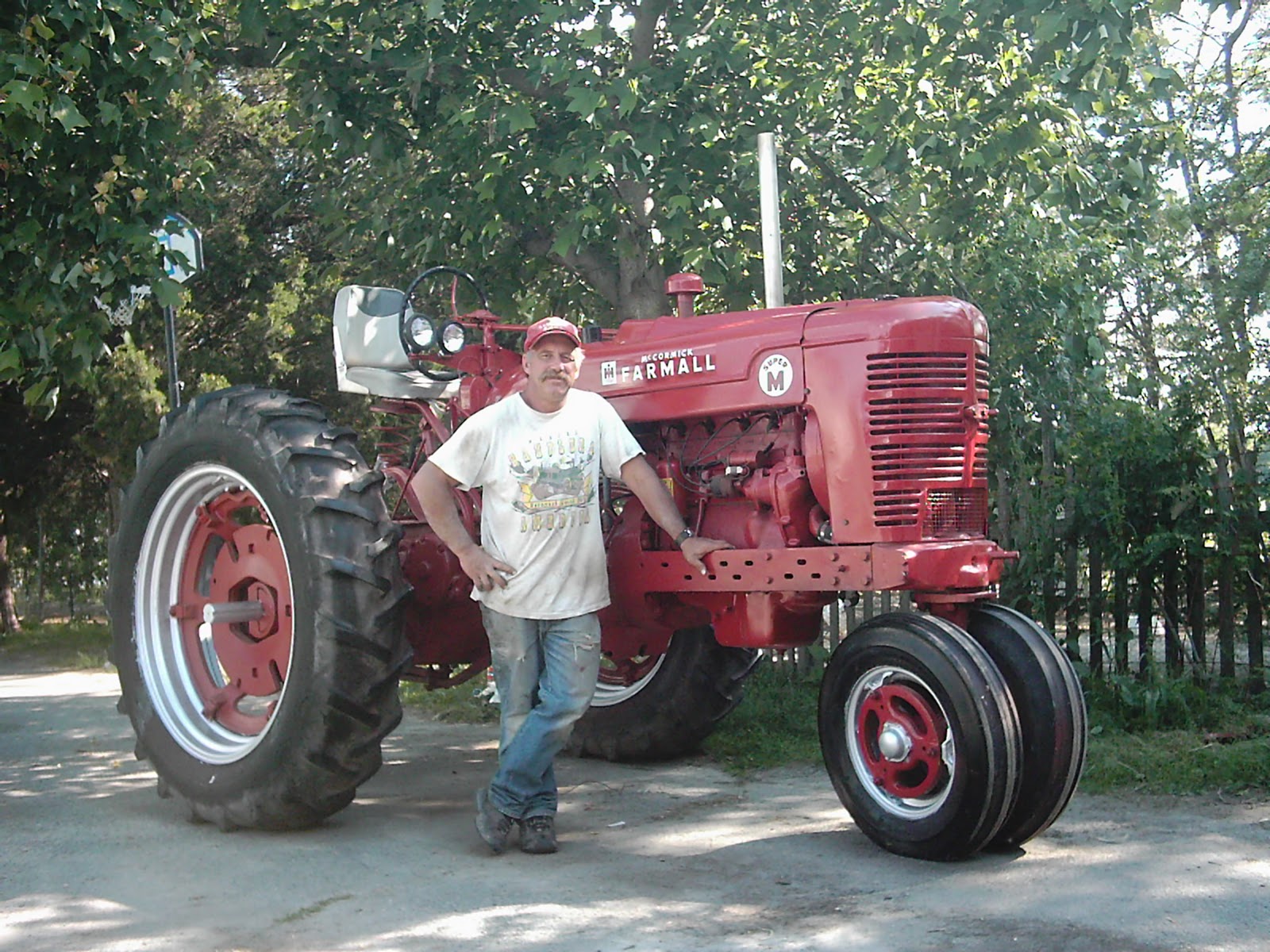
My father in front of his restored Farmall Super M
Growing up, I was not a fan of living on a small farm. When I was 10 years old, I wanted nothing more than to live in a place with sidewalks. I was defiant in living in the sticks. I was pretty ungrateful of this gift. But looking back, living on a small farm had a big impact in my life. This is a recap of growing up on a small farm. The farm is named Triple-M-Farms, and our website can be found here.

Let me back up, starting with my parents. My parents, by and large, aren't from a grower's background. My mother grew up in Detroit, and her only connection to agriculture was her grandfather's garden. From what I've heard, he had quite the green thumb, perhaps that's where my mother gets it from. My father, grew up in the small town of Warren, PA, which is near Erie. Both my parents met while working at a summer stock theater in Indiana, my dad was doing set design and construction, my mother is a "not-so-amateur" actress. They even were married in a theater. 

After their marriage, they found work in Delaware, yes, the state. My father is a teacher by trade. My mother is a registered nurse (RN) at the local hospital here. Again, there's not much of a connection here to agriculture. However, my parents are very insightful. In 1985, they moved to an old farmhouse about 5 miles from the nearest town. The farm is pretty small, it's 12 acres of arable land. Arable comes from the latin word arare, which means "to plough". In addition to the 12 acres of arable land, we also have a large (what I call large, mainly because it took forever to weed) garden. When I mapped it out, it's only about a tenth of an acre, but it feels much larger when you have to hand weed everything. Early on, we grew alfalfa, and sold the hay to horse owners. It was a nice little way to supplement our income. 

Since I was born, we have expanded. In the course of 22 years, we have tried our hand at various crops, whether it's vegetables, herbs, chickens, beef cattle, pigs, and even honeybees. I always took this experience for granted, but looking back, this was something that my parents did, not just for themselves, but also for my sister and me. I remember one night at dinner, I must have been 5 or 6 years old, we were talking about why we grew some of our own food. We still went to the grocery store every other week, but my parents informed me that growing your own food is an important skill. I vividly remember my mother asking me, "what would happen if there was a disaster, and there was no way to get food?" Right there, I realized how important it is to have that skill. Knowing how to grow your own food is a valuable insurance policy in the event of disaster. 

I often wonder where I would be without this experience during my childhood. I can recall some of my fondest memories were on the farm. There's something to be said about spending an afternoon baling hay with friends or family. My mother can attest that my favorite activity in the garden was digging for potatoes. It's a satisfying feeling to plunge your hands into the soil and come up with a good sized spud. I always equated it to a treasure hunt, but instead of finding wealth in the form of gold coins, wealth was in the form of a Yukon gold potato, a symbol of grower independence. My first job was actually working at the local farmer's market, which I also remember fondly.

One of the big jokes in our state is when winter weather hits. The first thing that happens when the meteorologist predicts a snowstorm is people stock up on milk and bread, and it's more true than we would like to admit. When I was a child, I was always amused by this, because I never quite understood why people rushed to the grocery store when snow is coming. As I've grown older, I realize now that people are stockpiling, in the event of a blizzard. This is something that we did throughout the summer and fall. I can distinctly remember my mother in the kitchen preparing excess vegetables for freezing or canning. Growing up, we never really bought vegetables, or steak for that matter. We grew it here on the farm.

So, my question to you, the readers: how often do you visit a grocery store? How long do you think you could go without going to the grocery store if you needed to? say, if you were snowed in.

Sunday, January 22, 2012

What is Agriculture? The Beginning

When you hear the word "agriculture", what comes to mind? Most people think, farming. However, this is only part-true. First, let's look at the word itself. The word agriculture, as with most words comes from a Latin word, agricultura. If we split the word down into agri, which means field, and cultura which translates into cultivation, we find that agriculture's literal translation from Latin is cultivation of the fields. This is a series of  the history of the "cultivation of the fields".

Imagine a world where your entire livelihood was searching and gathering food. From sunrise to sunset, all you and your family does is hunt and gather. The nomadic nature of your family means that you move with the food, and instead of a nice 3 bedroom 2 bath ranch house, it's a tent. I mean, why build a house when you need to follow migration patterns of the animals. This is a rough way of living, and because you spend all day looking for food, there isn't enough time to really do anything else, all you do is eat, sleep, and search for food. This is what life was like in 11,000BC.

Fast forward to 8,000BC, the fertile crescent in a region of Mesoptamia, a Hebrew word which translates to "land between 2 rivers". This region is in what is now modern-day Iraq (the two rivers being the Tigris and Euphrates). People got smart about their food supply. I couldn't imagine how revolutionary it was to think, "I'm going to GROW my own food". Now, this wasn't something that happened overnight, and this revolution didn't discontinue the hunter-gatherer way of life. It did, however, allow a shift. Now, instead of hunting and gathering all day, you're able to grow food, either on the side, or in its entirety. For the time, this was a totally new idea.

Fast forward again about 2,000 years, it's 6000BC, in the Nile River Valley, what is now modern day Egypt. The area was very fertile, and was flooded annually, which deposited all sorts of debris onto the fields, but most importantly, it provided nutrition to plants. Could you imagine if your livelihood was all dependent on what we consider today to be a natural disaster? There is a reason that the Egyptians were so advanced, and that is agriculture. Think for a minute, if you are able to grow enough of your own food, and enough to feed your neighbor, then your neighbor is now free to do something else. This was another revolution. This was a shift from subsistence agriculture, a system where you grow just for yourself or your family, to supporting more and more people. Some of the people are now free to specialize. The crazy part of this story is it's repeated again and again throughout history, in Asia, Europe, even in the United States. This is the natural progression of civilization.

Agriculture is responsible for civilization itself. If that nomad didn't think to grow his own food, where would we be today? We wouldn't be able to enjoy our free time, because we wouldn't have any free time. While many of my friends hunt seasonally, it's a totally different story when you come home empty-handed and go to bed hungry.

This is the beginning of the story, I will continue going through the history of agriculture and note major events throughout the journey of people as we became more and more advanced. And it all started with a nomad that had a new idea on how to feed his family.

Saturday, January 21, 2012

Introduction:


A few days ago, I read an article that bothered me. I wasn't bothered so much by the content, as I was from the attitude. The article was College Majors That are Useless, and I was expecting to find a bunch of obscure majors, and to my surprise, the author noted Agriculture as #1 most useless major, Animal Science as #4, and Horticulture as #5. Now, the information used to justify the author's views may lead you to think he is right. And while I could sit here and rant about how important agriculture is, and how my plant science knowledge is by no means useless, I would like to, instead, address a much grander problem facing this nation.

The author, along with countless other Americans have lost their roots to agriculture. This is much more of a heartbreak to me than anyone calling my major/career useless. I honestly don't know whether to be angry at people like this, or feel sorry for them. There seems to be a growing disconnect between growers, who produce the food, and the consumers who buy the food. And while this may not seem like a problem, it is.

My goal with this blog is to educate everyone on where the ag products you use every day, got their start, and how they ended up on your kitchen table, in your pantry, in your cupholder. I intend to learn just as much during this project as you, the readers will. I am interested in ALL forms of agriculture, and will try to spread out the topics to capture a broad spectrum of readers.

I am hoping to take you along the path of ag production from the field, to processing, to the household. I am not interested in chastising anyone on their carbon footprint, or not eating organically. That's a life choice that is none of my business. I would also like to plot out the path on a map to thoroughly illustrate the various steps within the ag system. If there is a topic you would like me to report, feel free to email me or leave a comment. I am just as interested in learning where my food, drink, clothing, and other household products come from.

Stay tuned for updates weekly (that's the plan at least). I'll try to cover an aspect of agriculture weekly, whether it's a specific crop or a specific product in the household. I am very open to suggestions on topics to cover.